Chauffeur Tours
Travel in Luxury & Style
Sit back, relax, and let our expert driver-guides show you the magic of the Celtic Isles. Enjoy premium vehicles, local insights, and VIP access to attractions.
Chauffeur Tour Packages
Browse our collection of luxury chauffeur-driven experiences
The Chauffeur Experience Includes
Expert Driver-Guide
Knowledgeable locals with fascinating stories
Luxury Vehicles
Premium Mercedes and Range Rover fleet
VIP Access
Skip-the-line entry at top attractions
Full Flexibility
Customize stops and pace as you go
Chauffeur Tours by Country
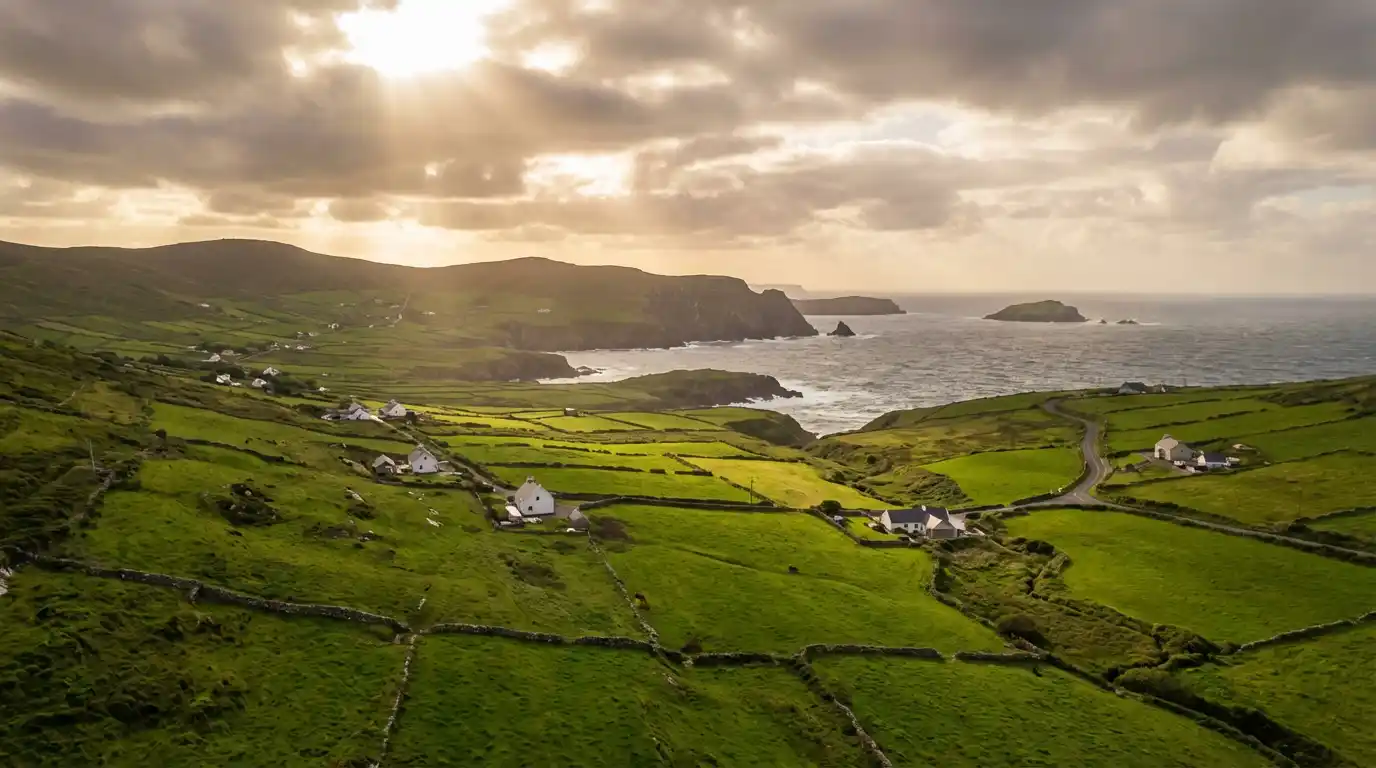
Ireland
Discover the magic of Ireland with our expertly crafted tours. From the rugged Wild Atlantic Way to the historic streets of Dublin, experience the best of the Emerald Isle with Celtic Vacations.
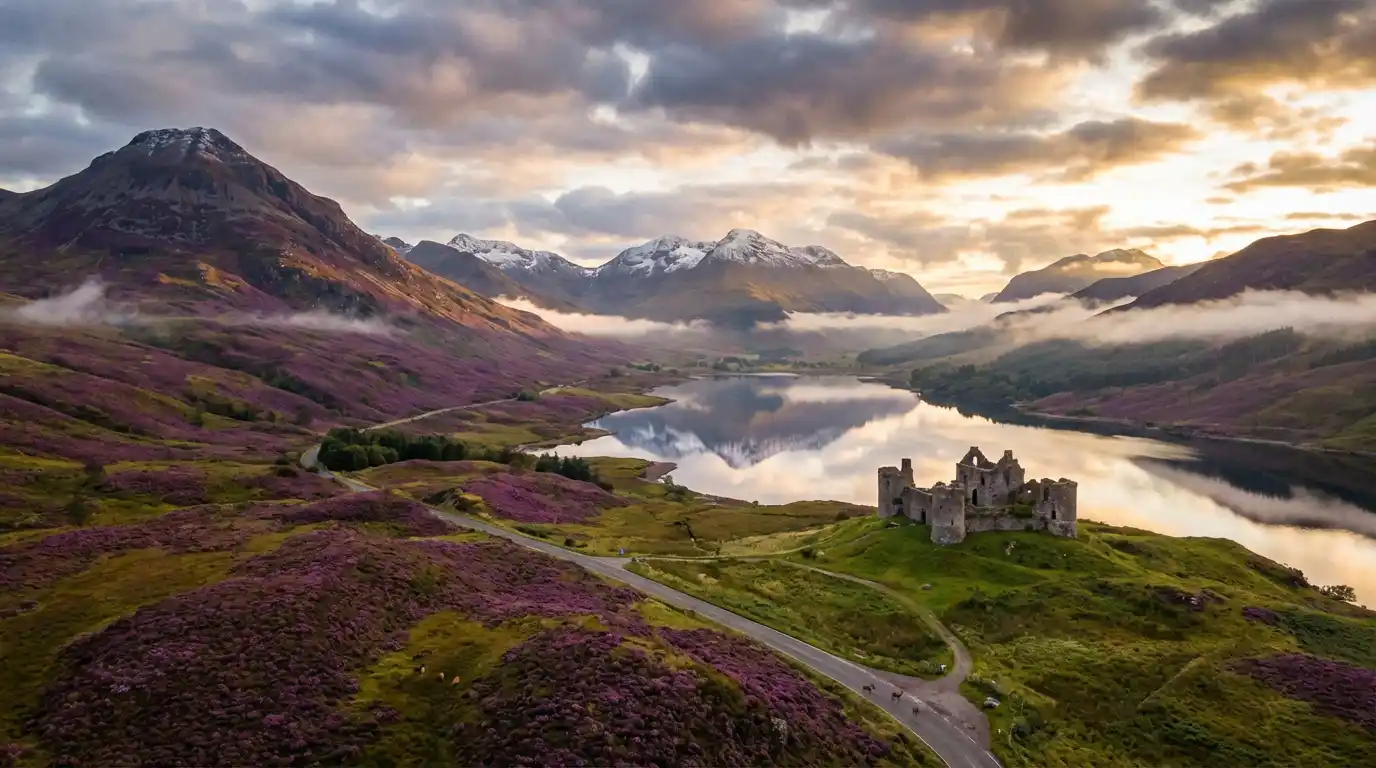
Scotland
Experience the breathtaking beauty of Scotland with our tailored tours. From the majestic Highlands to the historic castles, discover Scotland's rich heritage and stunning landscapes.
Popular Chauffeur Destinations in Ireland
 Featured
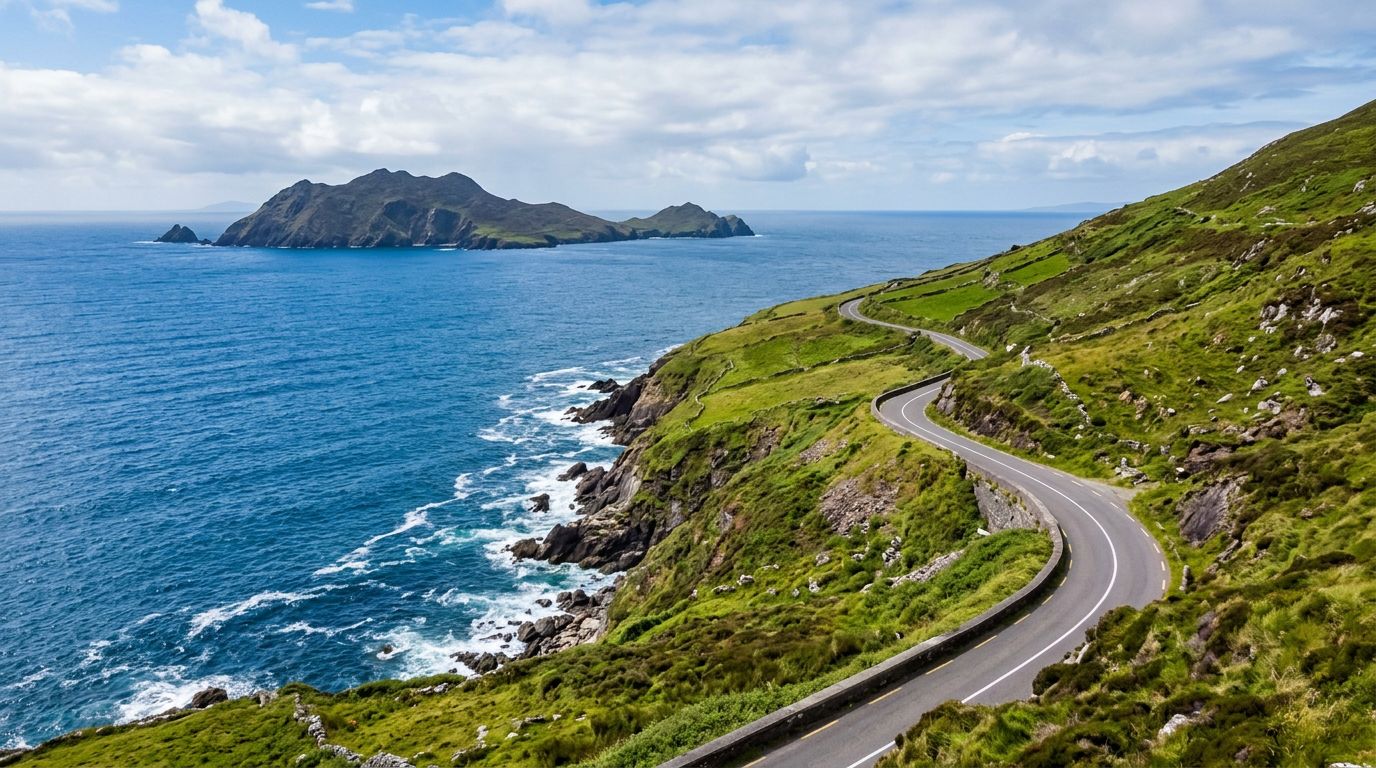
Dingle Peninsula
The Dingle Peninsula is the northernmost of Kerry's three Atlantic peninsulas, reaching further west into the ocean than any other point on the Irish mainland. It is a Gaeltacht area — Irish is the first language in many of the villages along the western coast — and this cultural identity shapes the peninsula's character as much as its geography. Dingle town sits roughly halfway along the peninsula's southern coast, a compact harbour town with a reputation for seafood, traditional music, and a social atmosphere that belies its small size. The narrow streets are lined with brightly painted pubs and restaurants, and on any evening of the week you can find live music in at least half a dozen venues. The harbour is the town's working heart — fishing boats land catches that appear on restaurant menus the same evening. West of Dingle, the Slea Head Drive is a 38-kilometre clockwise loop along the R559 that traces the peninsula's most dramatic coastline. The road passes Ventry Beach, the Iron Age promontory fort at Dunbeg, the Fahan group of beehive huts, and rounds Slea Head itself — the most westerly point, with views of the Blasket Islands sitting in the Atlantic. Dunquin Pier, a zigzag path cut into the cliff face, is the departure point for boats to Great Blasket Island. Gallarus Oratory, near the drive's end, is a perfectly preserved early Christian stone church shaped like an upturned boat. North of Dingle town, the Conor Pass (R560) climbs to 456 metres — one of the highest mountain passes in Ireland — through a glacial landscape of corrie lakes, hanging valleys, and bare rock. The summit car park offers views south over Dingle Bay and north to Brandon Bay and the Maharees. The pass road is narrow, steep, and not suitable for large vehicles.
 Featured
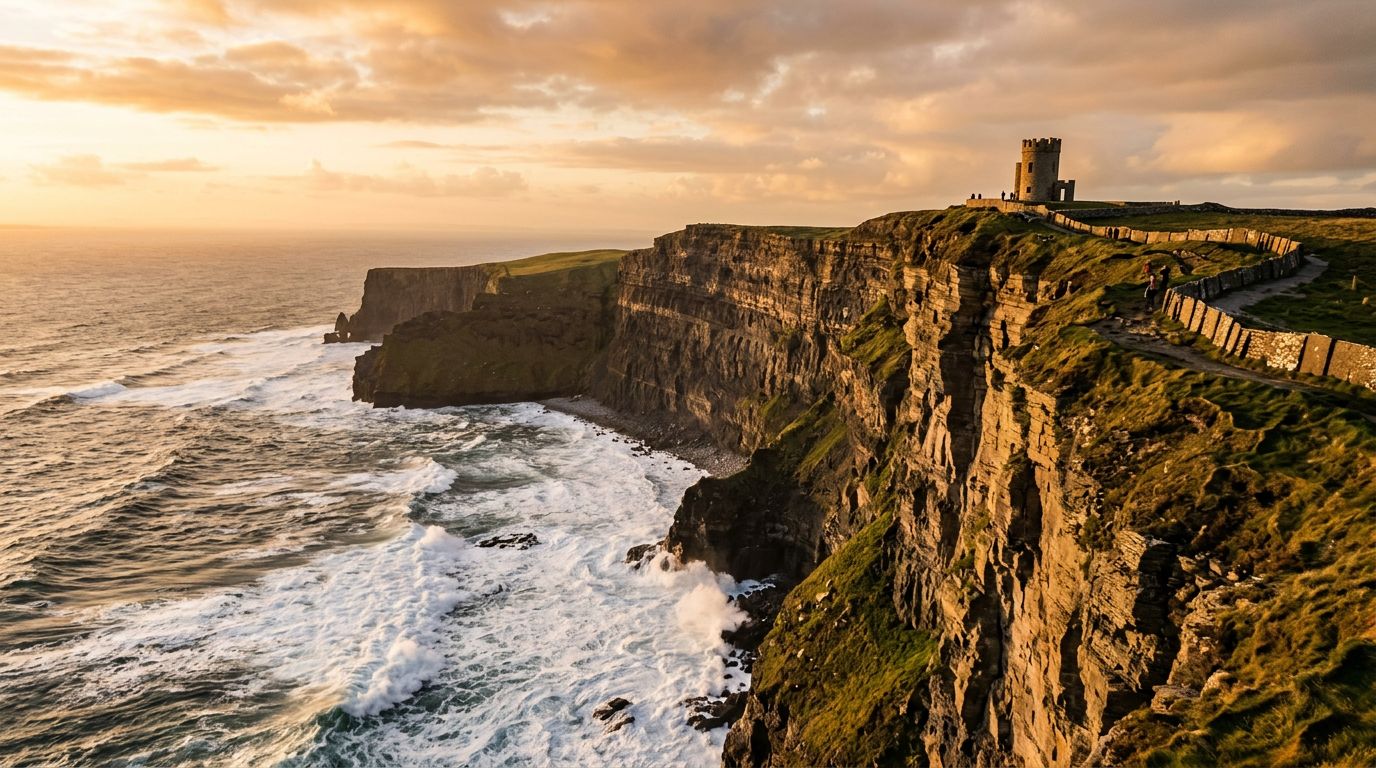
Clare
County Clare occupies the Atlantic coast between Galway Bay and the Shannon Estuary, a compact county that packs three of Ireland's most distinctive landscapes into a single day's driving. The Cliffs of Moher rise 214 metres above the Atlantic on the western coast, stretching 8 kilometres from Liscannor in the south to Doolin in the north. They are Ireland's most visited natural attraction and one of the most recognisable landmarks along the Wild Atlantic Way. Inland, the Burren is a 250-square-kilometre expanse of limestone karst that looks like no other landscape in Ireland — or anywhere else. The bare grey rock, cracked into a grid of fissures called grikes, supports a remarkable botanical mix: Mediterranean, Arctic, and Alpine plants grow side by side in the sheltered crevices, a combination found nowhere else in the world. The Poulnabrone Dolmen, a 5,800-year-old portal tomb standing in the middle of the limestone pavement, is the Burren's most photographed monument. Doolin sits between the Cliffs and the Burren, a village that has become synonymous with traditional Irish music. Gus O'Connor's Pub, McGann's, and MacDiarmada's host music sessions most evenings, drawing musicians from across the country. Doolin is also the departure point for ferries to the Aran Islands — Inis Oírr, the smallest island, is a 20-minute crossing. Beyond the headline trio, Clare offers the Loop Head Peninsula — a 64-kilometre drive from Kilkee to the lighthouse at Loop Head, where dolphins are frequently spotted from the cliffs. Bunratty Castle and Folk Park, near Shannon Airport, is a well-preserved 15th-century tower house with a reconstructed 19th-century village. The county town of Ennis has a compact centre with its own traditional music scene, centred on Brogan's Bar and Ciaran's Bar.
 Featured
Donegal
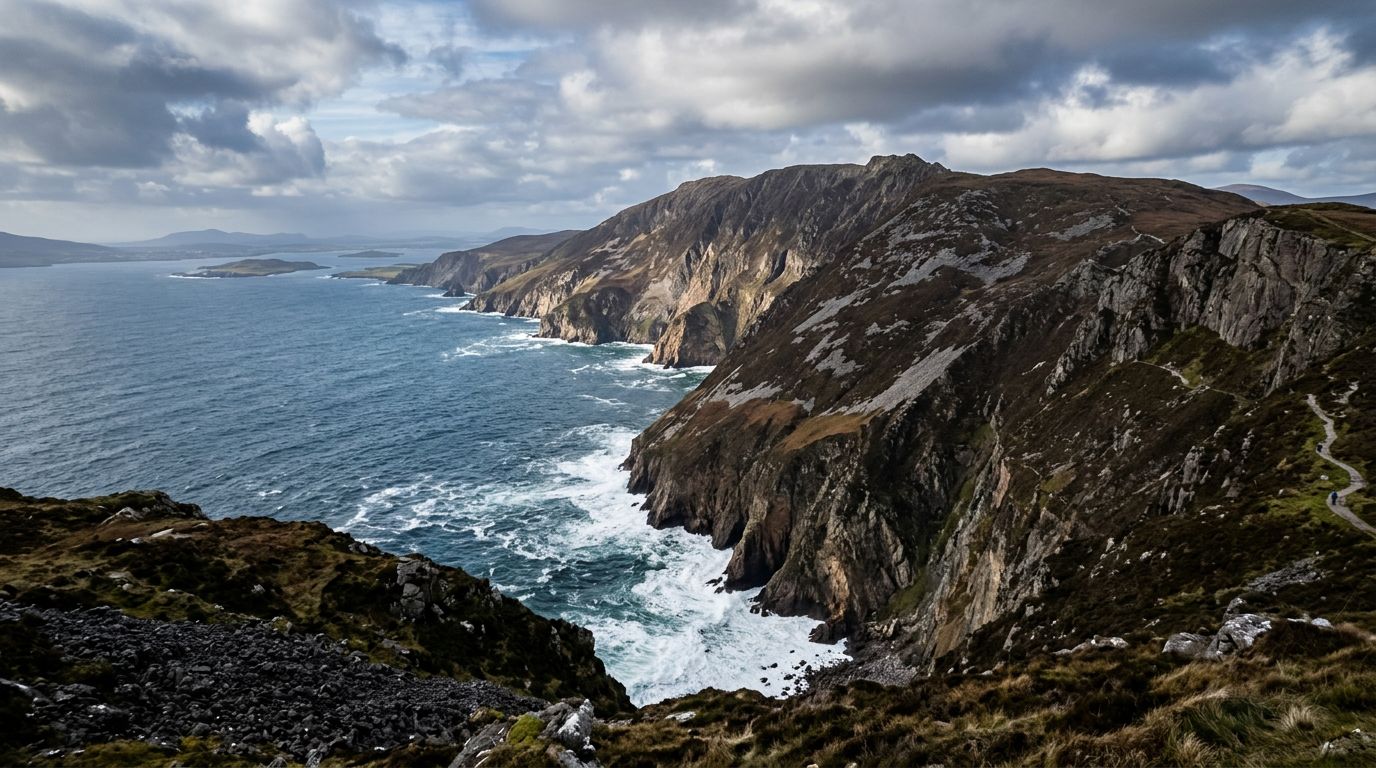
County Donegal occupies Ireland's remote northwest corner, a sprawling county of mountain, bog, and Atlantic coastline that feels more distant from Dublin than its 270 kilometres suggest. It holds some of the most dramatic landscapes in the country — and some of the least visited, because its position beyond the reach of the main motorway network keeps the crowds at bay. Slieve League, on the southwest coast near the fishing port of Killybegs, is the county's most dramatic single feature. The sea cliffs rise to 601 metres — nearly three times the height of the Cliffs of Moher — making them among the highest accessible sea cliffs in Europe. You can drive to the Bunglas viewing point or walk the One Man's Pass ridge for vertiginous views of Donegal Bay and the Sligo Mountains beyond. Below, at the harbour of Teelin, a memorial marks the departure point of fifth-century monks who sailed to Iceland. The northern coast is a different world. Fanad Head Lighthouse, at the tip of the Fanad Peninsula, has been voted one of the most beautiful lighthouses in the world. The drive around the peninsula — a 75-kilometre loop via the Harry Blaney Bridge connecting Fanad to the Rosguill Peninsula — follows the edge of Lough Swilly past white-sand beaches and clear Atlantic water. Malin Head, on the Inishowen Peninsula, is the northernmost point of mainland Ireland and the start (or end) of the Wild Atlantic Way. The rocks here are among the oldest in Ireland, and the headland was used as a filming location for Star Wars: The Last Jedi. Between the coasts, Glenveagh National Park covers 16,000 hectares of mountain, bog, and lake in the centre of the county. The castle at its heart, a 19th-century building overlooking Lough Veagh, is surrounded by gardens that include species from around the world. The Inishowen 100 — a 160-kilometre signposted driving loop around the Inishowen Peninsula — takes in Malin Head, the Gap of Mamore, Five Finger Strand, and the walled town of Derry at its eastern end.
 Featured
Causeway Coastal Route
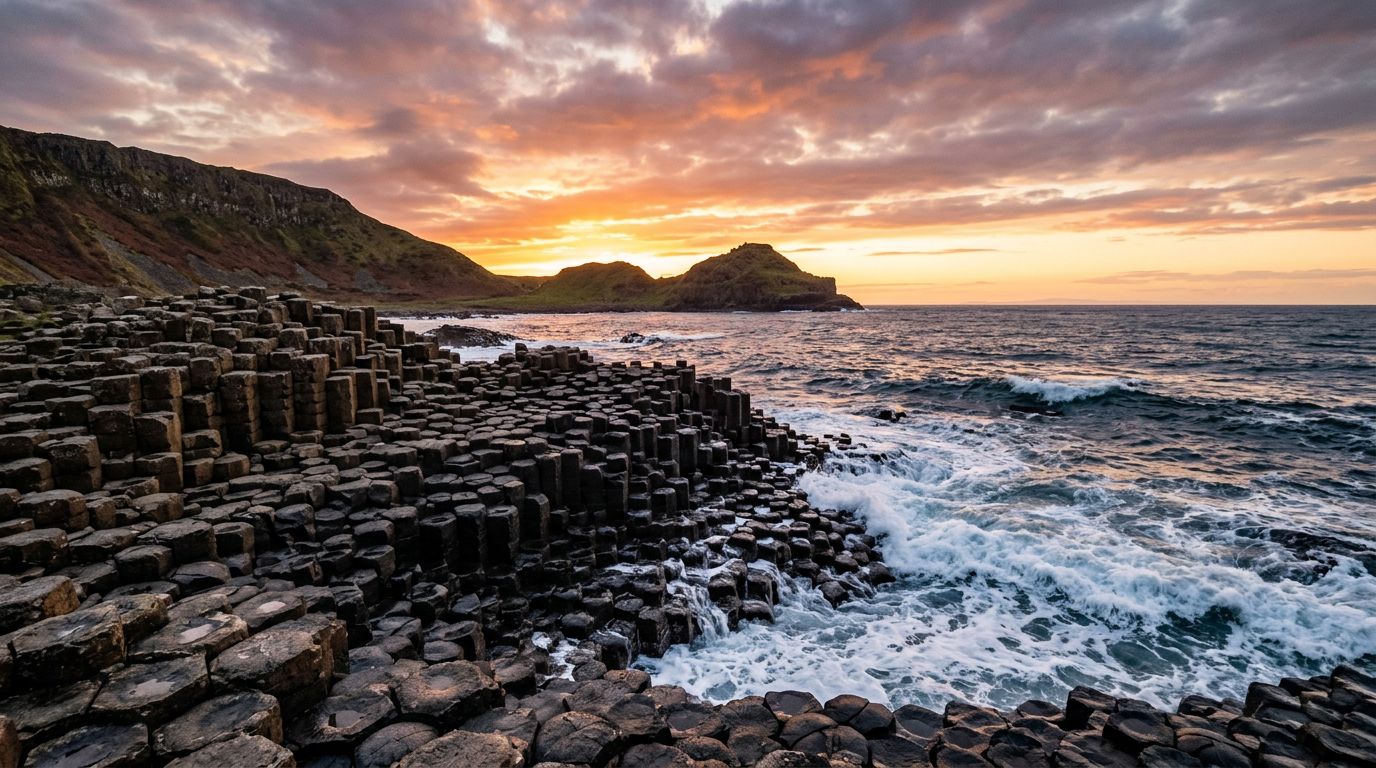
The Causeway Coastal Route is a 120-mile (190-kilometre) driving route along the north coast of Northern Ireland between Belfast and Derry/Londonderry. Consistently rated among the world's greatest coastal drives, it combines dramatic geology, ruined clifftop castles, the nine Glens of Antrim, and a UNESCO World Heritage Site into a single linear journey. The Giant's Causeway is the route's centrepiece — a formation of roughly 40,000 interlocking basalt columns, formed by an ancient volcanic eruption, stepping down from the cliff into the North Atlantic. It is Northern Ireland's only UNESCO World Heritage Site and one of the most visited natural attractions in Ireland. The visitor centre, managed by the National Trust, sits above the columns and offers audio-guided tours. The Carrick-a-Rede Rope Bridge, near Ballintoy, is a 20-metre rope bridge slung 30 metres above the sea, connecting the mainland to a small island once used by salmon fishermen. Nearby, Ballintoy Harbour — a photogenic cove with limestone rocks and a small stone quay — served as the Iron Islands harbour in Game of Thrones. The Dark Hedges, an avenue of gnarled beech trees planted in the 18th century, appeared as the Kingsroad in the same series and is one of the most photographed spots in Northern Ireland. Dunluce Castle, between Bushmills and Portrush, is a dramatic clifftop ruin perched on a basalt outcrop above the Atlantic. Parts of the castle kitchen fell into the sea during a storm in 1639. Bushmills Distillery, in the nearby village, holds the title of the world's oldest licensed whiskey distillery, with tours running year-round. The Glens of Antrim — nine glacier-carved valleys running from the mountains to the sea — fill the route's middle section between Belfast and Ballycastle. Glenariff, the widest glen, has a waterfall walk through a forested gorge. The coastal villages of Carnlough, Cushendall, and Cushendun are well-preserved and atmospheric stopping points.
 Featured
Dublin
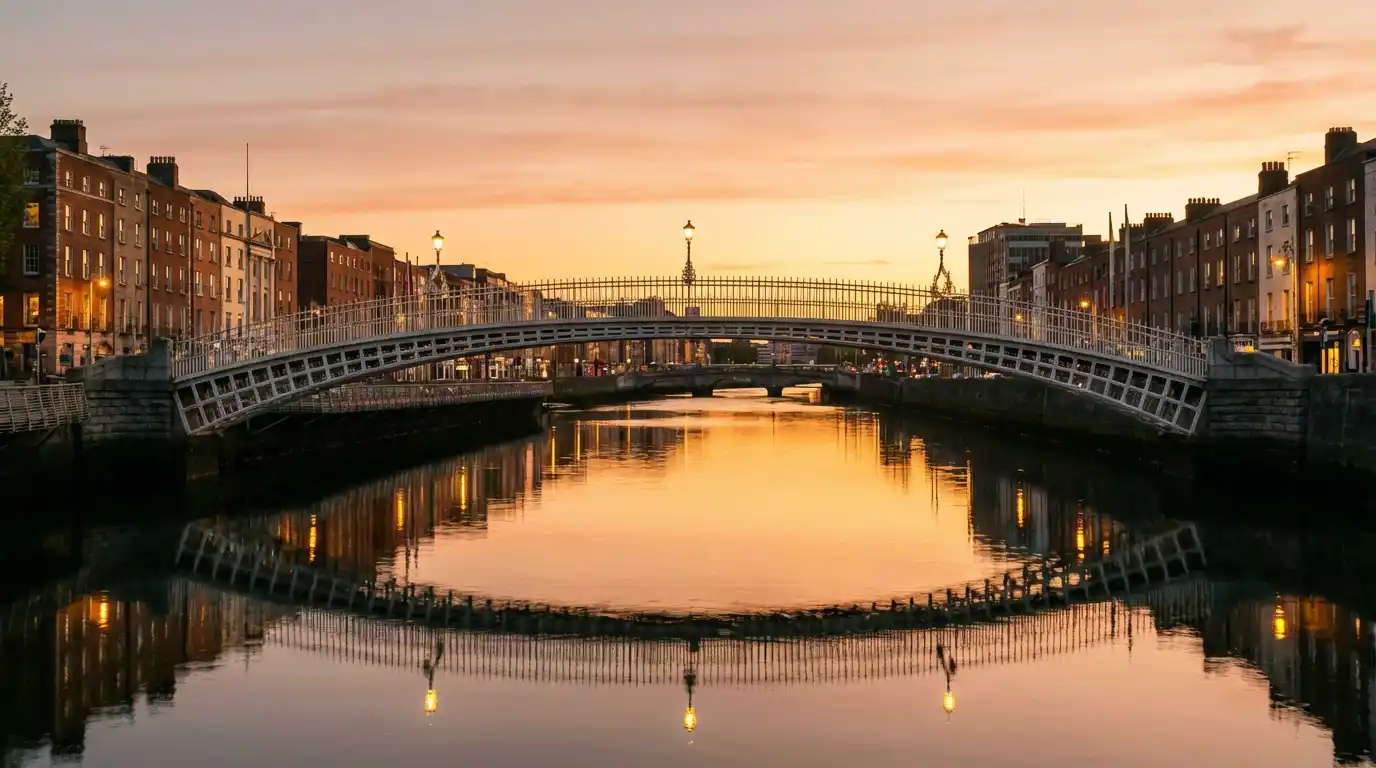
Dublin is Ireland's capital and largest city, home to over 1.4 million people in its greater metropolitan area. Situated on the east coast at the mouth of the River Liffey, the city has been a centre of commerce, culture, and political power since the Vikings established a settlement here in the 9th century. The city divides naturally along the Liffey into the Northside and Southside. South of the river, Trinity College — founded in 1592 — anchors the university quarter, while the Georgian terraces of Merrion Square and Fitzwilliam Square form one of the finest collections of 18th-century architecture in Europe. Grafton Street connects Trinity to St Stephen's Green, one of the city's largest public parks. North of the Liffey, O'Connell Street runs past the General Post Office, a key site in the 1916 Easter Rising, toward the rejuvenated Smithfield and Stoneybatter neighbourhoods. Dublin's literary heritage is unmatched for a city of its size. James Joyce, Oscar Wilde, Samuel Beckett, and W.B. Yeats all called the city home, and their presence is woven into the streetscape — from the Oscar Wilde statue in Merrion Square to the James Joyce Tower in Sandycove. The city hosts Bloomsday on June 16th each year, retracing the steps of Leopold Bloom through the Dublin that Joyce immortalised in Ulysses. Beyond the centre, Dublin's coastline stretches from the fishing village of Howth in the north to the Victorian pier towns of Dún Laoghaire and Dalkey in the south. The Wicklow Mountains rise just 50 kilometres to the south, offering an easy escape into rugged upland scenery. To the north, the Boyne Valley holds some of Ireland's most important archaeological sites, including the passage tomb at Newgrange.
 Featured
Galway
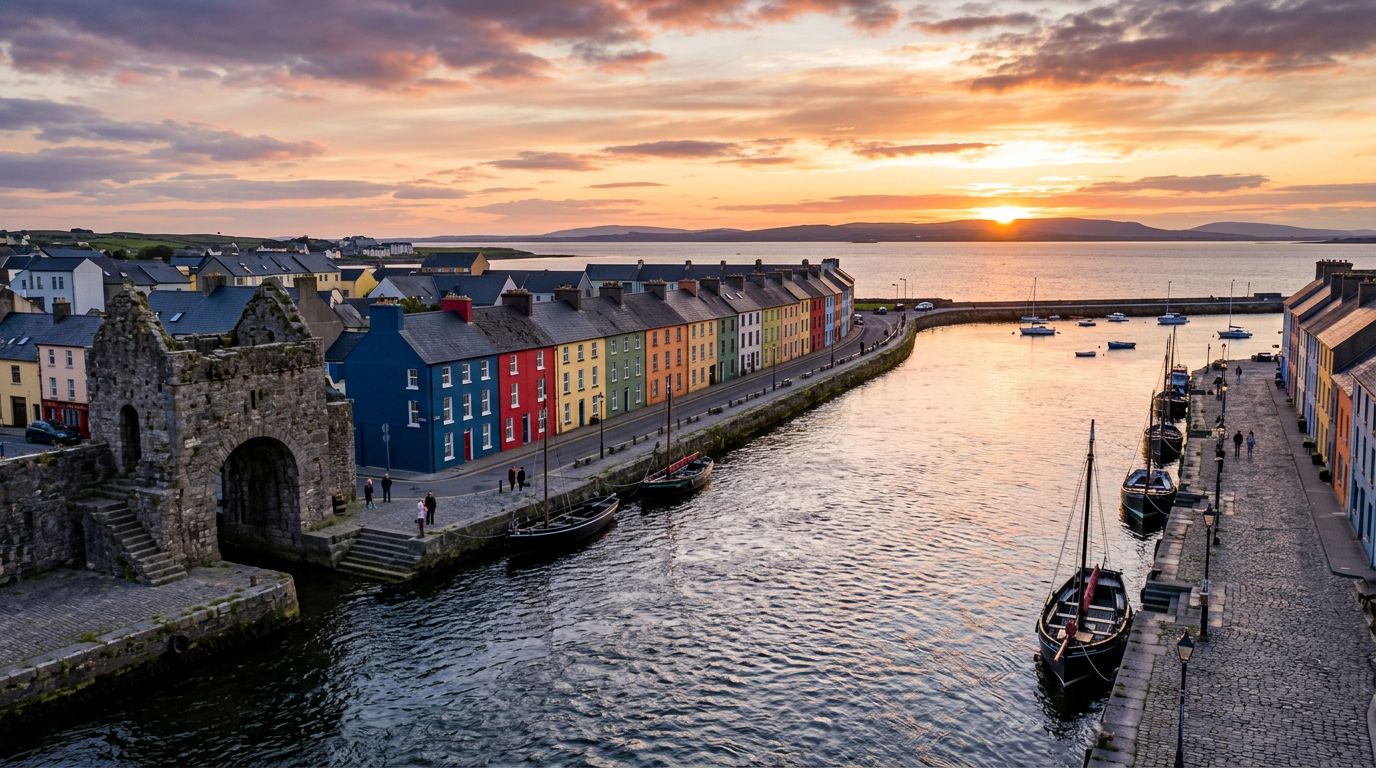
Galway sits on Ireland's Atlantic coast, a compact city that punches well above its weight for culture, food, and live music. The Latin Quarter — centred on Shop Street and Quay Street — is a pedestrian-friendly tangle of painted shopfronts, buskers, and restaurant terraces that stays lively well into the evening. The Spanish Arch, one of the last remnants of the medieval city walls, overlooks the mouth of the River Corrib where it meets Galway Bay. Across the bridge, the Claddagh — once an independent fishing village — gave its name to the famous ring design that originated here. The city is the gateway to Connemara, a wild stretch of bog, lake, and mountain that begins less than an hour's drive west. Clifden, Connemara's unofficial capital, anchors the Sky Road — a 16-kilometre coastal loop with views across island-studded Clifden Bay. Connemara National Park at Letterfrack offers the Diamond Hill walk, a well-maintained trail that climbs to panoramic views of the Twelve Bens mountain range. Kylemore Abbey, a 19th-century Benedictine monastery on the shore of a lake, is one of the most photographed buildings in the west of Ireland. Off the coast, the Aran Islands — Inis Mór, Inis Meáin, and Inis Oírr — preserve a way of life that has all but disappeared on the mainland. Ferries from Rossaveal, a 45-minute drive from the city, reach Inis Mór in about 40 minutes. There, the Bronze Age fort of Dún Aonghasa sits on the edge of a 100-metre cliff, and the island is best explored by bicycle. Galway has earned its reputation as Ireland's festival capital. The Galway International Arts Festival fills two weeks in July with theatre, visual art, and street performance. The Galway Races follow immediately after — a week-long horse racing festival that doubles as the city's biggest social event. In September, the International Oyster and Seafood Festival, the world's longest-running oyster festival, rounds out the summer season.
Popular Chauffeur Destinations in Scotland
 Featured
Scottish Highlands
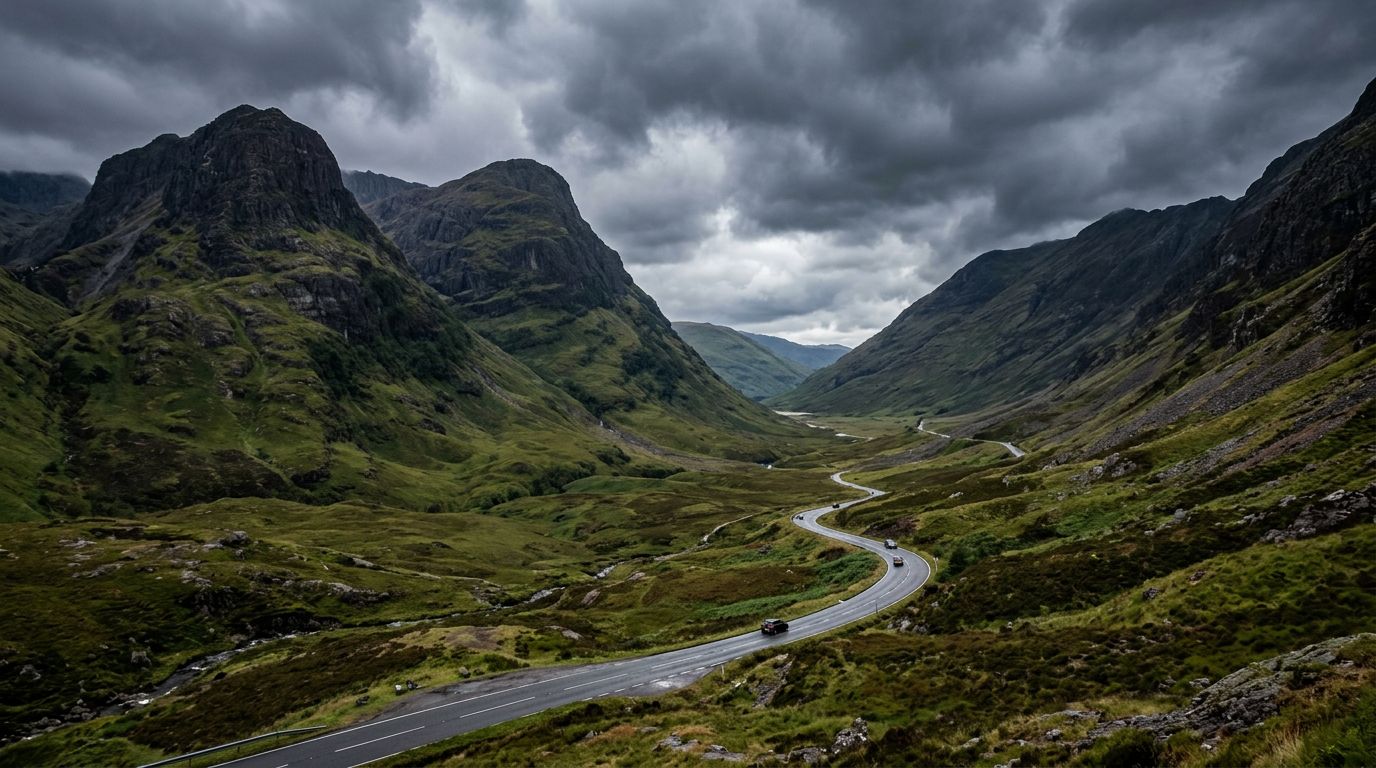
The Scottish Highlands are a landscape on a scale that exists nowhere else in Britain. Vast glens carved by glaciers, mountains rising above 1,000 metres, sea lochs penetrating deep inland, and a human history of clan warfare, Jacobite risings, and the Highland Clearances — all set against some of the most dramatic scenery in Europe. Glen Coe is arguably Scotland's most dramatic valley. The A82 road cuts through a narrow pass flanked by towering volcanic peaks — the Three Sisters on the south side, Buachaille Etive Mor guarding the eastern entrance. This was the site of the 1692 Massacre of Glencoe, when government soldiers killed 38 members of the MacDonald clan in violation of the laws of hospitality. The National Trust for Scotland visitor centre tells the story with restraint and the surrounding walks range from gentle glen paths to serious mountain routes. Ben Nevis, at 1,345 metres (4,413 feet), is the highest mountain in the British Isles. It rises above Fort William — self-styled Outdoor Capital of the UK — and the main Pony Track is a serious 17-kilometre round trip taking 7 to 10 hours. The approach through Glen Nevis is spectacular even without attempting the summit. Eilean Donan Castle sits on a small tidal island where three sea lochs meet — Loch Duich, Loch Long, and Loch Alsh. It is the most photographed castle in Scotland, connected to the mainland by a stone bridge. The current building is a 20th-century reconstruction of the medieval original, destroyed in 1719 during a Jacobite rising, but it photographs beautifully and the interior is well-presented. Entry is approximately £13. The Glenfinnan Viaduct — famous from the Harry Potter films as the route of the Hogwarts Express — carries the West Highland Railway across 21 arches. The Jacobite Steam Train crosses from April to October; book at least 60 days in advance. The Glenfinnan Monument at the head of Loch Shiel marks where Bonnie Prince Charlie raised his standard in 1745.
 Featured
Glasgow
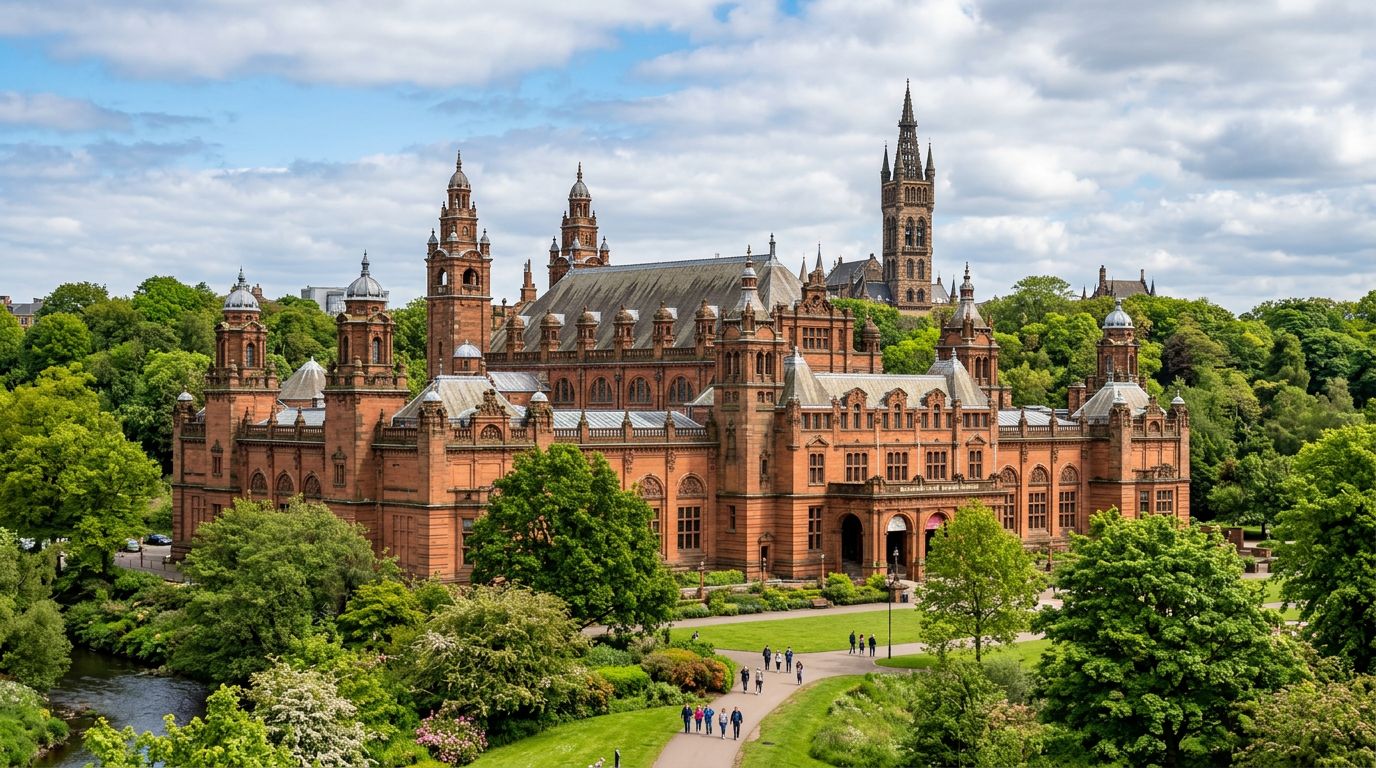
Glasgow is Scotland's largest city and its cultural engine. Where Edinburgh trades on medieval grandeur, Glasgow's personality is built on industry, reinvention, and a creative energy that has made it one of Europe's most rewarding city breaks. Most of its world-class museums are free, its music scene rivals any city its size, and its Victorian and Art Nouveau architecture is genuinely outstanding. Kelvingrove Art Gallery and Museum is Glasgow's crown jewel and one of the most visited free museums in the United Kingdom. Housed in a red sandstone Baroque Revival building in the city's West End, it holds over 8,000 objects across 22 themed galleries. Highlights include Salvador Dali's Christ of Saint John of the Cross, a Spitfire suspended from the ceiling, Scottish Colourist paintings, and collections spanning ancient Egypt to the natural world. Entry is free. The Riverside Museum, designed by the late Zaha Hadid and winner of the European Museum of the Year Award, sits on the north bank of the Clyde. Its zinc-clad zigzag roof houses over 3,000 objects telling the story of transport by land, sea, and air — from vintage trams and locomotives to a recreated 1930s Glasgow street. Moored outside is the Glenlee, one of only five Clyde-built sailing ships still afloat. Both museum and tall ship are free. Glasgow Cathedral is the only medieval Scottish mainland cathedral to have survived the Reformation intact. Behind it, the Glasgow Necropolis — a Victorian cemetery on a hill — offers atmospheric walks and city views. George Square showcases Victorian civic grandeur. The Burrell Collection in Pollok Country Park reopened in 2022 after a major refurbishment, housing Sir William Burrell's extraordinary collection of art and antiquities. Entry is free. Charles Rennie Mackintosh left his mark across Glasgow — the Lighthouse (Scotland's Centre for Design and Architecture), the Mackintosh at the Willow tearoom on Sauchiehall Street, and House for an Art Lover in Bellahouston Park. The Glasgow Mural Trail covers over 30 large-scale street art works across the city centre.
 Featured
Edinburgh
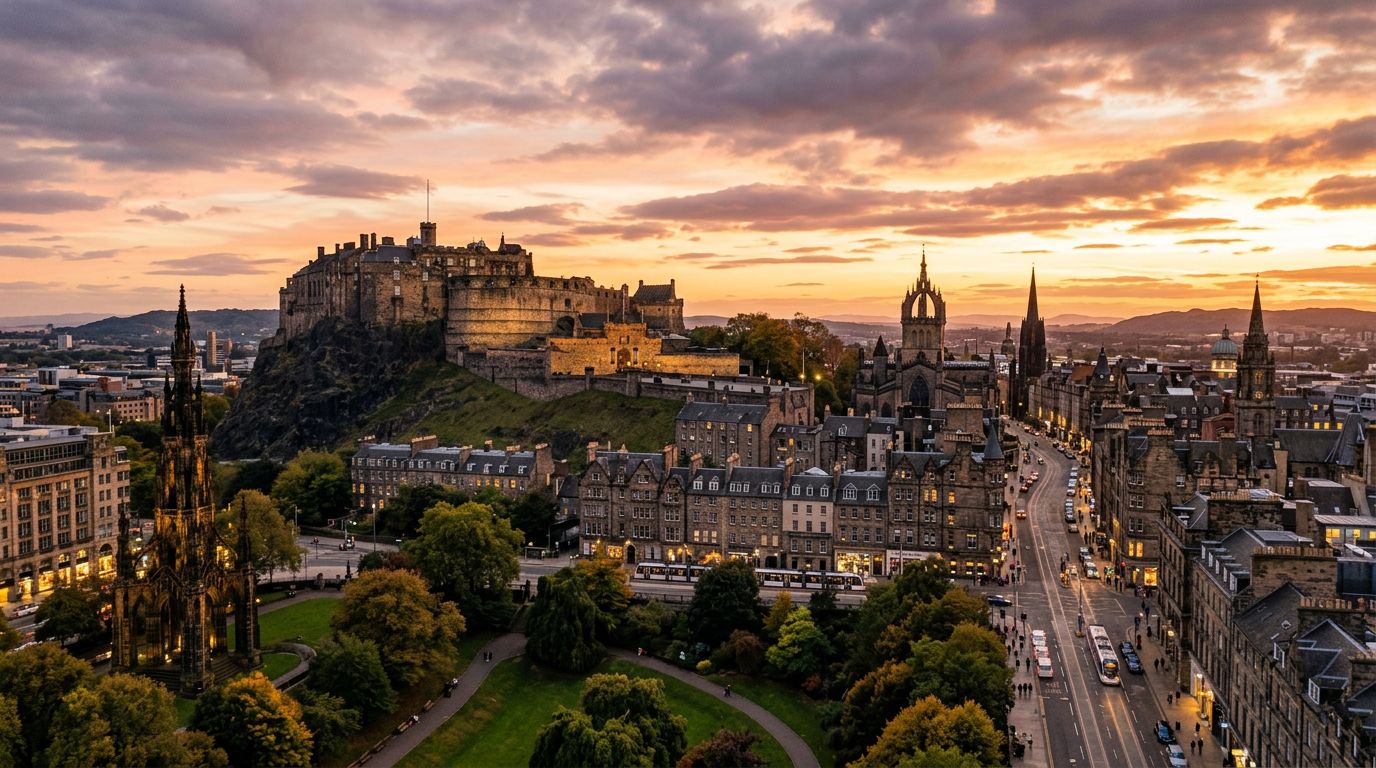
Edinburgh is a city built on geology and shaped by history. The Old Town rises along a volcanic ridge from the Castle at the summit to Holyrood at its base, its medieval tenements, narrow closes, and hidden courtyards largely unchanged in outline since the 16th century. The New Town, by contrast, is a masterpiece of Georgian urban planning — broad streets, elegant crescents, and classical facades laid out in the 1760s. Together they form a UNESCO World Heritage Site. Edinburgh Castle dominates the skyline from the top of Castle Rock, an extinct volcanic plug. Inside you will find the Honours of Scotland — the oldest crown jewels in Britain — the Stone of Destiny, St Margaret's Chapel (the city's oldest building), the medieval siege cannon Mons Meg, and the National War Museum. The One o'Clock Gun has been fired daily (excepting Sundays) since 1861. It is Scotland's most-visited paid attraction, drawing over two million visitors annually. The Royal Mile stretches 1.1 miles from the Castle Esplanade down to the Palace of Holyroodhouse, the official Scottish residence of the British monarch. Along the way, St Giles' Cathedral — with its 1500 crown steeple and the exquisite Thistle Chapel — stands at the heart of the High Street. The Scottish Parliament, designed by Enric Miralles and opened in 2004, offers free public tours. Camera Obscura, the Scotch Whisky Experience, the Real Mary King's Close, and John Knox's House (dating to 1470) all line the route. Beyond the Mile, Arthur's Seat — the main peak of an extinct volcano in Holyrood Park — rises 251 metres and rewards a moderate 45-minute climb with panoramic views of the city, the Firth of Forth, and the Pentland Hills. Calton Hill offers a shorter climb and equally spectacular views, with the National Monument and the Nelson Monument at its summit. The National Museum of Scotland and the Scottish National Gallery are both free to enter and world-class in scope.
 Featured
Isle of Skye
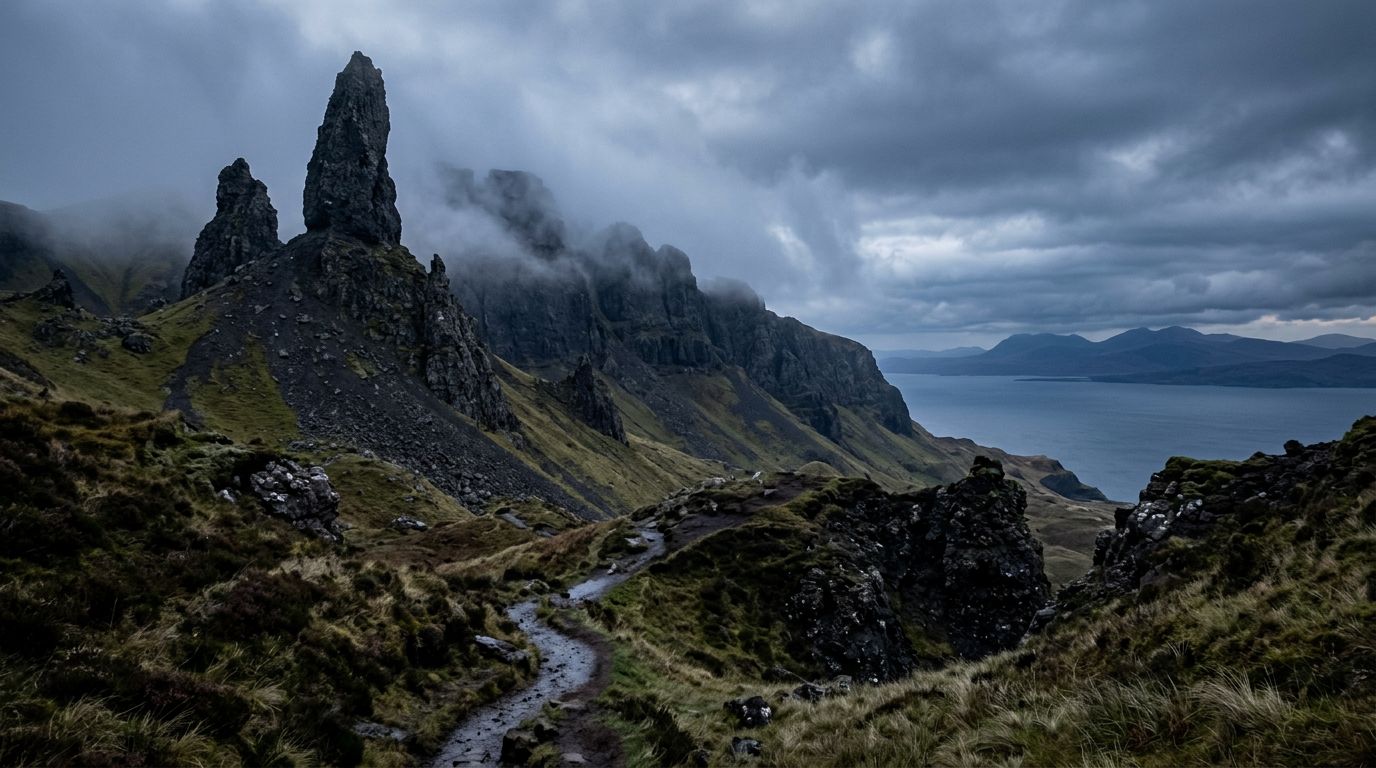
The Isle of Skye is the largest of Scotland's Inner Hebrides and one of the most visually dramatic places in Europe. Connected to the mainland by the Skye Bridge at Kyle of Lochalsh (toll-free since 2004), the island combines volcanic geology, medieval clan history, and landscapes so otherworldly they have served as backdrops for films, album covers, and countless photographs. The Fairy Pools in Glenbrittle sit at the foot of the Black Cuillin mountains. A series of crystal-clear pools and waterfalls connected by a well-maintained 2.4-kilometre path, they glow blue and green in good light. The water is cold year-round — wild swimming is popular but a wetsuit is advisable. The car park charges £5 and fills early in summer; arrive before 9am. The Old Man of Storr is the most iconic image of Skye. This dramatic basalt pinnacle rises to 719 metres on the Trotternish Peninsula, north of Portree. The hike from the car park is 4.5 kilometres return, taking 1.5 to 2 hours, with steep sections and muddy ground. The surrounding landscape of jagged spires and rocky outcrops looks almost alien, especially when wrapped in mist. The Quiraing, also on the Trotternish Peninsula, is an extraordinary landslip landscape of grassy plateaux, rock pinnacles, and hidden hollows. The circular walk takes 2 to 3 hours. Dunvegan Castle, seat of Clan MacLeod for over 800 years, has walled gardens and boat trips to a nearby seal colony. The Talisker Distillery at Carbost is the only distillery on Skye producing single malt whisky since 1830. Portree is the island's main settlement — a harbour front lined with brightly painted houses in shades of red, yellow, and blue. It has the best selection of restaurants, shops, and accommodation on Skye and is the most practical base for exploring the island.
 Featured
North Coast 500
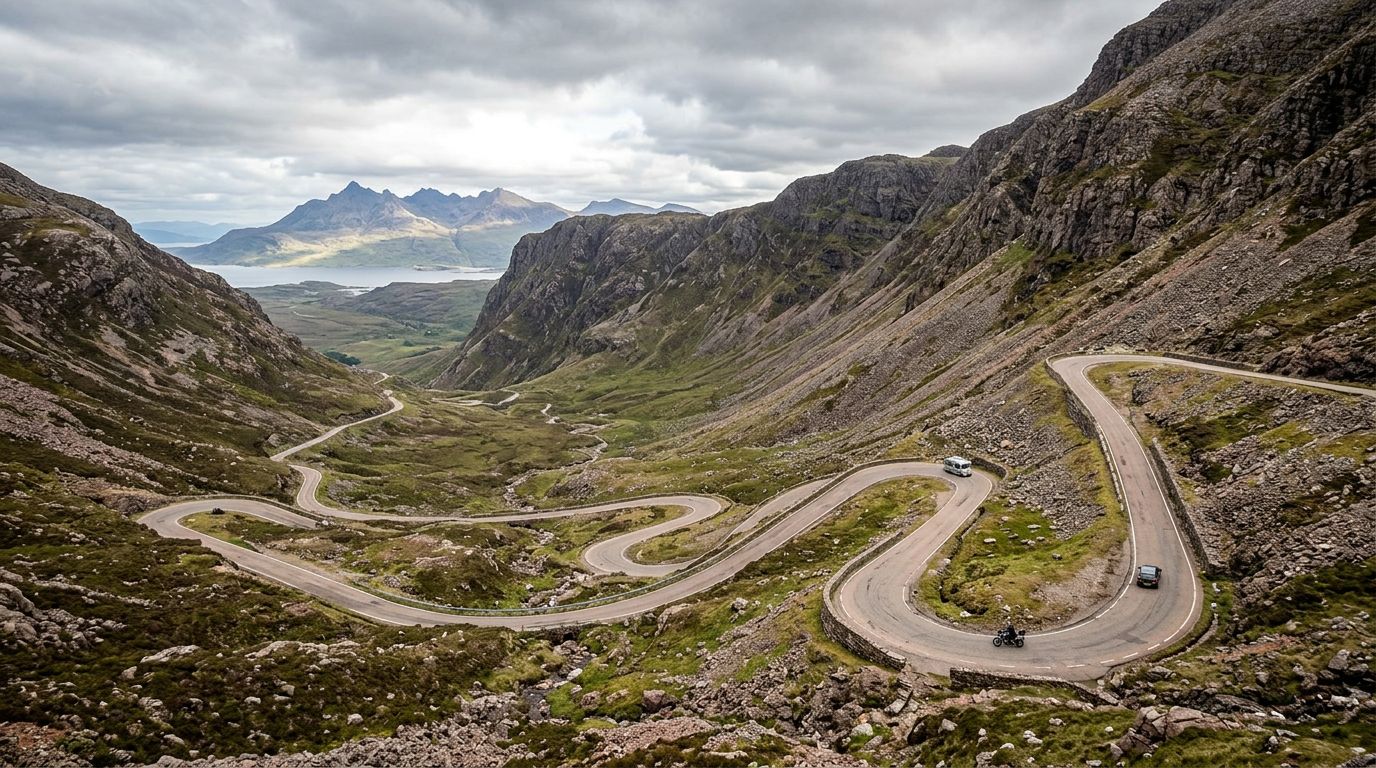
The North Coast 500 is a 516-mile signposted scenic driving route around the far north of Scotland, starting and ending at Inverness Castle. Often called Scotland's Route 66, it is widely regarded as one of the world's greatest road trips — a loop through five distinct landscapes stitched together: the gentle farmland of the Black Isle, the dramatic climb over Bealach na Ba to Applecross, the wild coastal stretch through Wester Ross and Assynt, the Atlantic edge along the north coast of Sutherland and Caithness, and a softer run south through Dornoch and back to Inverness. Bealach na Ba is the single most dramatic drive on the route. This mountain pass climbs from sea level to 2,054 feet in roughly six miles, with gradients of one-in-five and three tight hairpin bends near the top. The summit view, on a clear day, reaches to Skye and the Outer Hebrides. It is not suitable for large motorhomes or caravans — an alternative coastal road via Shieldaig is available. Applecross village at the foot of the pass is famous for the Applecross Inn. The wild stretch from Ullapool to Durness passes under the distinctive profiles of Suilven and Stac Pollaidh in Assynt, crosses the Kylesku Bridge, and heads north through some of the loneliest driving in Britain. Durness rewards with Smoo Cave — the most dramatic sea cave on the mainland, featuring an interior waterfall and summer boat trips — plus Sango Sands, Balnakeil Beach, and Ceannabeinne Beach. The north coast runs east through Tongue and Thurso to John o'Groats, where the Duncansby Stacks — dramatic sea stacks — are the real highlight. The east coast return passes Dunrobin Castle near Golspie (a fairy-tale French chateau transplanted to the Highlands) and the handsome town of Dornoch with its cathedral and championship golf course.
 Featured
Loch Ness
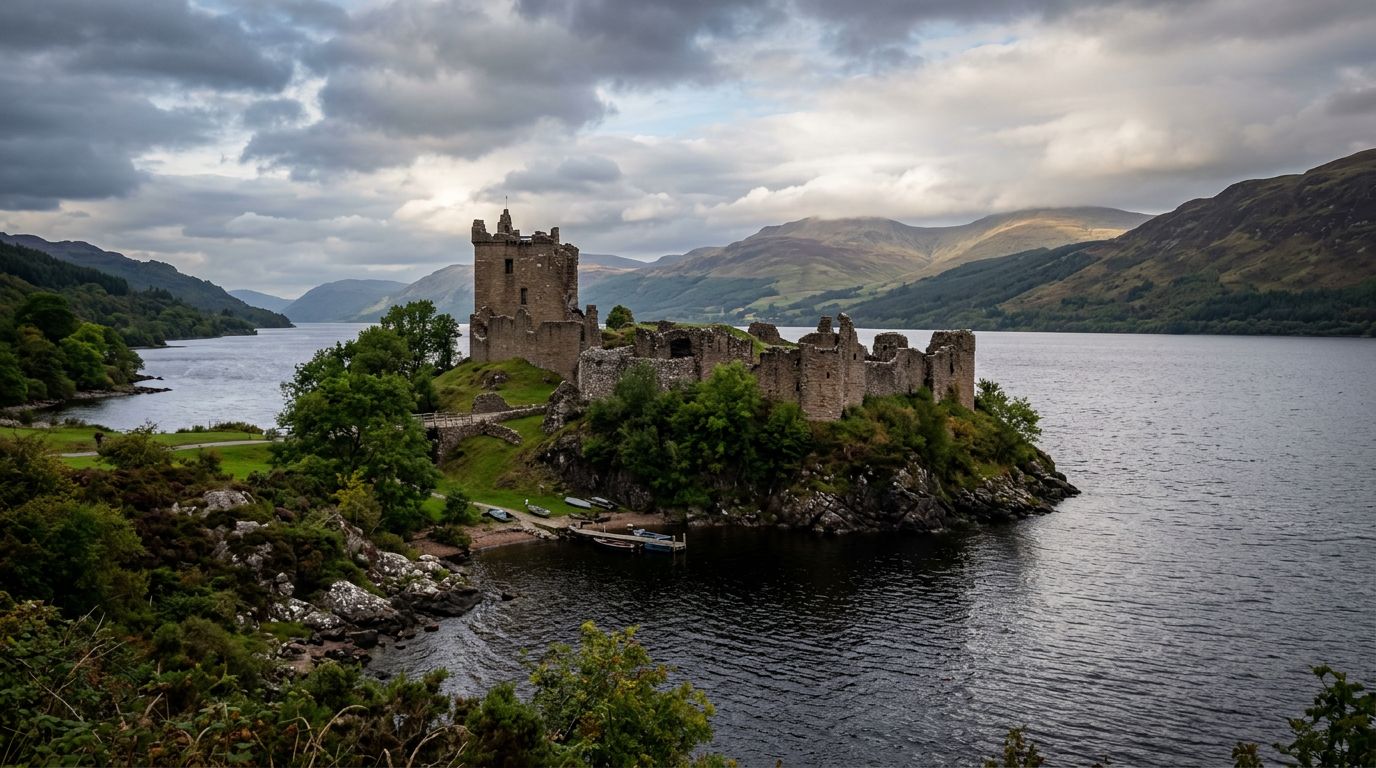
Loch Ness needs no introduction, but it deserves more than its monster. This is Scotland's most famous body of water — 23 miles long, up to 755 feet deep (deeper than the North Sea), and holding more fresh water than all the lakes of England and Wales combined. The loch sits in the Great Glen, a geological fault line that cuts Scotland in two from Fort William to Inverness. Urquhart Castle is the postcard image of Loch Ness. This medieval fortress ruin sits on a rocky promontory on the western shore, near the village of Drumnadrochit. Once one of Scotland's largest castles, it saw centuries of conflict between Scots and English during the Wars of Independence, and was finally blown up by retreating government troops during the Jacobite Risings. The Grant Tower survives almost intact and offers panoramic views up and down the loch. Entry is £14 online (£16 walk-up), managed by Historic Environment Scotland. Drumnadrochit is the hub for Loch Ness tourism. The Loch Ness Centre (£17) presents the history of the monster legend with scientific rigour. Several operators run boat cruises from Drumnadrochit and nearby piers — many equipped with sonar so you can watch the loch bed scroll past on screen. Fort Augustus sits at the southern end of the loch, where the Caledonian Canal meets the water through a dramatic flight of locks. Watching boats rise and fall through the locks is a relaxing spectacle, and the village has good cafes and a pleasant canal towpath walk. Inverness, at the northern end, is the Highland capital — a compact city with a Victorian castle overlooking the River Ness, a covered Victorian market, and a strong food scene. Culloden Battlefield, where the last pitched battle on British soil was fought in 1746, is 6 miles east of the city. The Jacobite defeat at Culloden ended the Stuart claim to the throne and changed Highland culture forever.
Let's start dreaming —
Ready for a Luxury Experience?
Let our experts help you plan the perfect chauffeur tour. We'll match you with the ideal driver-guide and create a bespoke itinerary just for you.